

FOB, CIF or DDP: Which delivery term fits your purchase?
If you buy or ship vehicles, machinery, or other bulky cargo, the question is rarely just “How much is freight?” It is usually: who takes care of the handoff, who pays what, and where does the risk move from seller to buyer? That is where FOB, CIF or DDP: Which delivery term fits your purchase? becomes a practical decision, not a legal footnote. The wrong term can leave a sourcing manager with surprise port charges, an incomplete customs file, or a shipment that looked inexpensive on paper but landed expensive in real life.
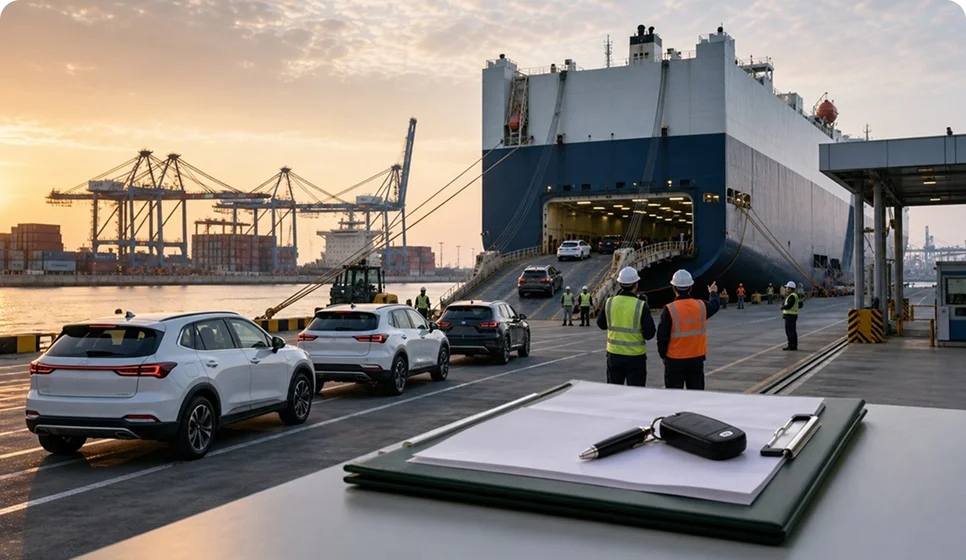
This matters even more in sea freight, where a container, a flat rack, or a roll-on/roll-off vehicle load can pass through several hands before it reaches the final consignee. A RoRo terminal, with its lane markings, loading ramps, and vehicle check-in paperwork, is a good reminder that logistics is built on handoffs. Delivery terms are the rules for those handoffs.
Start with the real question: where do you want responsibility to shift?
Most disputes around Incoterms-style delivery terms come down to one issue: people assume the seller is covering more than the term actually says. Others assume the buyer is responsible from the first mile, when the contract clearly puts some of the port-side costs on the seller. That gap causes trouble.
Think of the decision in three layers:
First, who arranges the main transport. Second, who pays for insurance, export clearance, import clearance, and terminal charges. Third, at what point the risk of loss or damage shifts. Those are not always the same thing, and buyers sometimes discover that too late.
FOB in plain language
FOB is often used in ocean shipping when cargo is loaded onto a vessel. In practical terms, the seller’s job usually ends once the goods are loaded on board at the named port of shipment. After that, the buyer carries the freight risk and often takes control of the main carriage arrangements.
For a vehicle shipment, FOB can make sense when the buyer already has a freight forwarder, knows the destination port procedures, and wants visibility into the international freight cost. It is a common choice for experienced importers who prefer to manage ocean freight themselves.
But there is a caution here. FOB sounds simple, yet the buyer still needs a functioning logistics chain. If you do not have reliable forwarding support, export paperwork coordination, and a clear understanding of port cut-off times, FOB can create avoidable delays. The seller may have done their part, but the clock does not stop there.
CIF: freight and insurance included, but not everything
CIF is often attractive because it appears to give the buyer a cleaner landed picture. The seller arranges and pays for the cost of carriage to the destination port and also provides insurance cover. That sounds convenient, and sometimes it is. For companies that do not ship often, CIF can reduce the number of moving parts they have to coordinate.
Still, CIF is not a door-to-door service. The buyer should not assume duties, destination port handling, inland delivery, or import clearance are included. In many purchasing disputes, the buyer hears “shipping included” and mentally fills in the rest. The contract usually does not.
There is also a practical detail buyers overlook: insurance under CIF is not always the same as “full protection from all problems.” The insurance level can be limited by the contract terms and the policy language. If you are moving high-value equipment or sensitive vehicle inventory, read the coverage rather than trusting the headline.
DDP: the seller carries the load farther, but not without a price
DDP pushes the seller’s responsibility further than most terms. In simple buyer-side language, the seller handles a large share of the journey, including transport to the named place of destination and import-related responsibilities. That makes DDP appealing to buyers who want predictability and a single delivered price.
For some purchasing teams, DDP is the easiest term to compare across suppliers. A single quote is easier to budget against than a freight line, insurance, port handling, customs charges, and local trucking all listed separately. That said, the apparent simplicity can be misleading if the seller has not quoted the term correctly or has built in a wide cushion for unknowns.
Buyers should be careful with DDP on cross-border shipments where the seller may not be well set up for local tax or customs obligations. If the seller cannot legally or practically manage those obligations in the destination market, the shipment can get stuck in a bureaucratic gray area. A low-price DDP quote is only useful if it is operationally real.
Quick comparison for buyers
Here is the decision in a practical form.
FOB works best when the buyer wants control over ocean freight and already has logistics support.
CIF is useful when the buyer wants the seller to arrange freight and insurance to the destination port, but is still willing to manage import-side steps.
DDP suits buyers who want the seller to carry most of the delivery burden and quote a more complete landed price.
None of these is automatically “better.” The best choice depends on your internal capability, the commodity, and how much risk you are willing to carry between port loading and final receipt.
Why this choice matters more for vehicles and RoRo cargo
Vehicle logistics has a habit of making contract wording very visible. In a RoRo operation, vehicles are driven onto the vessel, secured, and later driven off at the destination. That creates a chain of custody that is straightforward on the surface but still full of handoff points: yard receipt, vessel loading, sea transit, discharge, terminal release, and inland collection.
For new cars, fleet vehicles, or commercial units, those handoffs are where paperwork, condition reports, and release documents matter. A clipboard on the terminal table is not decoration; it represents the information trail that protects everyone if a vehicle arrives with damage or a missing item.
Because RoRo cargo is handled in an open, highly coordinated port environment, buyers should pay close attention to where their responsibility starts and ends. If your team assumes the seller is controlling more of the process than the contract allows, you may find yourself paying local port fees or handling customs surprises with little warning.
Selection criteria buyers should actually use
Your team’s logistics maturity
If you regularly import, FOB or CIF may be manageable. If your team is small or new to international shipping, DDP can reduce coordination load, provided the supplier is capable of delivering it correctly.
The destination market
Some destinations have straightforward clearance procedures; others are less forgiving. If import formalities are complex, the party taking responsibility for them needs real local experience, not just a line in the quote.
The cargo value and handling sensitivity
High-value machinery or vehicle inventory often justifies a more controlled shipping setup. For such cargo, the cheapest quote is rarely the most useful one if it leaves a gap in insurance or release responsibility.
Internal cost visibility
Some procurement teams want a clean delivered number. Others prefer cost transparency, even if it means more line items. Neither approach is wrong, but mixing them creates confusion. If your finance team hates surprises, DDP or a tightly structured CIF quote may be easier to work with. If your logistics team wants control, FOB often fits better.
Common mistakes that create avoidable cost
The first mistake is treating freight as the whole deal. It is not. Port charges, documentation fees, insurance, customs clearance, and inland transport can add up quickly.
The second mistake is assuming insurance means full-value protection. It often does not. Ask what is covered, where the coverage begins, and how claims are handled.
The third mistake is choosing a term that conflicts with your team’s operating model. A buyer with no customs capability should be cautious about taking on terms that require hands-on import management. Likewise, a supplier that lacks local delivery infrastructure should not be forced into a DDP promise it cannot support.
The fourth mistake is not aligning the commercial term with the physical reality at port. A vessel terminal, a loaded ramp, and vehicle handover paperwork all require coordination. If your contract ignores those realities, delays will surface later as costs.
Practical buyer advice before you sign
Ask the supplier to spell out exactly what is included and what is excluded. Do not rely on shorthand terms alone, especially if you are comparing multiple quotations.
Confirm the named port or destination. Small wording differences can change the responsibility boundary in ways that matter financially.
Check who issues the shipping documents and who receives them. A clean handoff on paper is just as important as the handoff at the terminal gate.
If the cargo is vehicles, ask how condition is recorded at dispatch and receipt. That matters more than many purchasing teams realize. A simple inspection note can save a long dispute later.
And if one quotation is dramatically cheaper than the others, read it again. Sometimes the difference is efficiency. Sometimes it is missing scope.
Which term fits which buyer profile?
Choose FOB if you want freight control, have a capable forwarding partner, and are comfortable handling the shipping leg yourself.
Choose CIF if you want the seller to organize freight and insurance to the destination port, but you are still prepared to manage destination-side costs and clearance.
Choose DDP if you want the broadest seller responsibility and the simplest buyer-side budgeting, and you trust the seller to execute destination formalities properly.
If your company ships vehicles through RoRo terminals, the answer often comes down to how much operational work you want on your desk after the cargo reaches the port. Some teams prefer control. Others prefer convenience. Most need a mix of both, but the contract has to reflect which side matters more.
FAQ: a few questions buyers ask late in the process
Is the cheapest term always the best?
No. The cheapest quoted price can hide inland charges, customs costs, or extra risk. Compare the total burden, not just the first number you see.
Can I use the same term for every shipment?
Sometimes, but not always wisely. A repeat order of standard goods may suit one term, while a one-off vehicle shipment or an urgent project cargo may call for another.
What if my supplier and freight forwarder define responsibilities differently?
Then you need the contract language reviewed carefully. Informal practice is not enough when a shipment is delayed or damaged.
Next step for procurement and logistics teams
Before you accept a quote, map the shipment from factory gate to final delivery point and mark who is responsible at each stage. If the answer is not obvious, ask for a revised quotation that separates freight, insurance, customs, and terminal handling in a way your team can actually use. That one exercise will tell you whether FOB, CIF or DDP: Which delivery term fits your purchase? is a commercial question or a contract problem waiting to happen.
For vehicle shipments and other port-handled cargo, the best deal is rarely the one with the shortest headline. It is the one that matches your team’s capability, the destination market, and the amount of risk you are willing to own when the cargo rolls off the vessel and onto the dock.