

How do you evaluate battery health and real-world EV range?
If you ask a service manager, fleet buyer, or technically minded EV owner how do you evaluate battery health and real-world EV range?, the honest answer is that you need to look beyond the dashboard estimate. Range numbers on a screen are useful, but they are not the same thing as usable capacity, charging behavior, or how the vehicle performs under real duty cycles. That gap matters in workshops, fleet operations, and resale decisions, because a vehicle can still look “normal” while quietly losing efficiency or charging consistency.
In practical terms, battery health tells you how much of the original energy storage is still available, while real-world range tells you what the vehicle can actually do under the conditions that matter to the buyer. One is a technical condition. The other is a business result. A good evaluation ties the two together.
What the visible diagnostic setup suggests
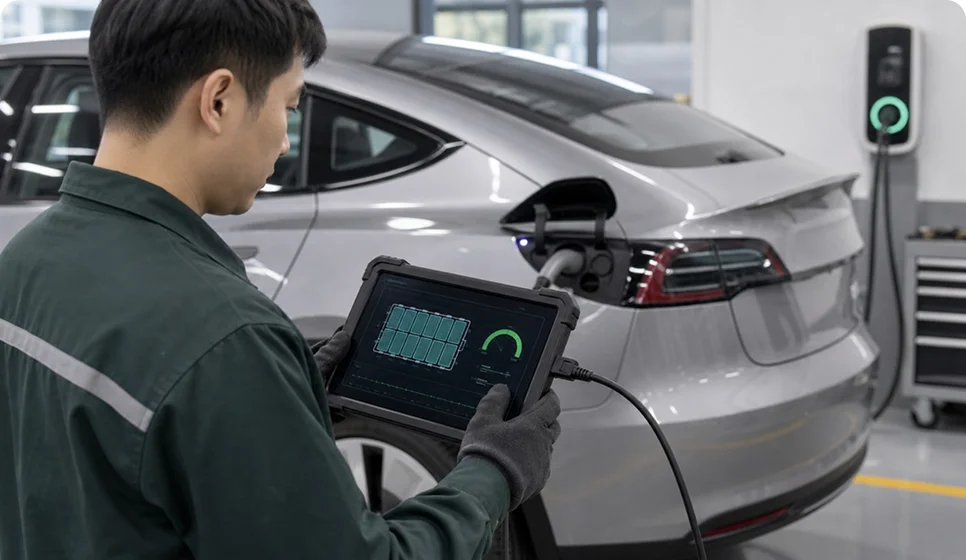
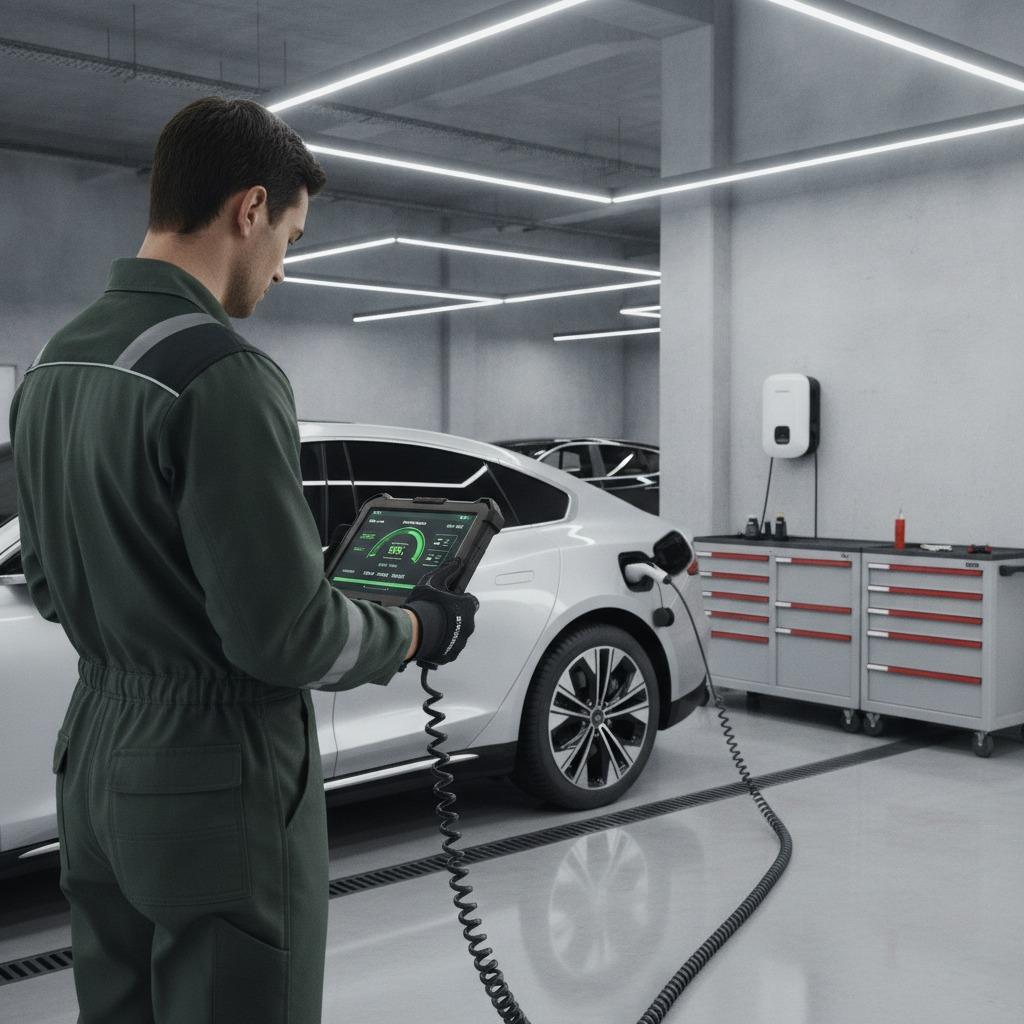
The device shown is a ruggedized tablet or handheld industrial computer connected by cable to a vehicle’s charging or diagnostic interface. The on-screen battery-style grid and gauge indicate live status monitoring rather than a simple consumer app. That matters because EV inspection is often not just about reading a number; it is about observing the charging system in action.
For service bays, dealership technicians, and fleet maintenance teams, that kind of setup is useful for checking charging behavior, battery status, and connector communication during a session. It is not especially glamorous equipment, but it is the sort of tool that helps separate a healthy pack from one that is merely still functioning.
Battery health and EV range are related, but not identical
Many buyers treat battery health as a shortcut for range. That is understandable, but it can be misleading.
Battery health usually refers to the condition of the pack relative to its original state. Depending on the system and the diagnostic tool, this may be represented as state of health, remaining capacity, cell balance, or evidence of charging irregularity. Real-world range is the result of battery condition plus many other variables: vehicle weight, temperature, speed, terrain, driving style, HVAC load, tire condition, software calibration, and even route profile.
A vehicle with a respectable battery health reading may still deliver disappointing range if it is driven at highway speeds in winter with heavy climate control use. On the other hand, a degraded pack might still seem acceptable in a local delivery route with gentle speeds and frequent stops. That is why serious evaluation uses both lab-style indicators and field-style observation.
A quick-reference way to think about the assessment
1. Start with the battery condition
Look for diagnostic data that helps answer whether the pack is storing and releasing energy evenly. If the system can show live status, charging progression, or a battery grid visualization, use that information to check for obvious anomalies. Uneven behavior across the pack can point to aging, imbalance, or communication faults.
2. Then look at charging behavior
A battery that charges smoothly is often a better sign than one that behaves erratically under load. If charging pauses, fluctuates, or fails to communicate consistently with the vehicle or station, the issue may not be the battery alone. Sometimes the problem is the interface, cable, or control logic.
3. Finally, compare against real use
Ask what route the vehicle actually runs. City duty, delivery stops, suburban commuting, towing, and highway travel all produce different range outcomes. A proper evaluation compares the observed or predicted range against the intended duty cycle, not some idealized brochure condition.
What technicians and buyers should measure
If you are trying to decide whether an EV is suitable for continued service, resale, or fleet assignment, focus on measures that can be defended in front of a buyer or repair order.
The most useful checks include:
Charging status during a live session
i.e. whether the vehicle accepts charge normally and maintains a stable conversation with the charging hardware.
Battery capacity indicators
These help estimate how much usable energy remains, though the exact meaning depends on the vehicle and software.
Cell or module balance, where available
Large imbalances can reduce usable range even if the pack still charges.
Energy consumption under expected use
A commuter car and a service van do not need the same test route.
Temperature and environmental conditions
Cold weather can make a healthy battery look worse than it is; heat can be its own problem, especially over time.
Road test results or controlled drive data
This is where the diagnostic reading meets the real world. Without it, range estimates can be too neat to trust.
Common mistakes that distort the answer
One mistake is relying on a single dashboard estimate. Those figures are helpful for drivers, but they are not the full picture. Another is testing range on a day that is nothing like the vehicle’s normal use. A pleasant spring commute tells you very little about winter fleet performance.
There is also a tendency to overread a charging screen without understanding what it shows. A battery-like graphic or gauge is useful for status monitoring, but unless you know what the software is measuring, you should avoid making grand claims from a single visual indicator. That is especially true with unidentified or general-purpose diagnostic tablets. The hardware may be rugged and suitable for the shop floor, but the meaning of the data still depends on the vehicle system and the software behind it.
A third mistake is ignoring charging-interface problems. Some range complaints are actually charging communication issues, not pack degradation. That can waste a lot of time if the diagnostic process starts in the wrong place.
How real-world EV range should be tested
For buyers and service teams, the best range test is repeatable. It should reflect the vehicle’s actual duty cycle as closely as practical.
If possible, use the same route, similar payload, similar ambient temperature, and similar speed pattern each time. For a fleet vehicle, that may mean a loop that mirrors delivery work rather than a generic mixed-road drive. For a passenger EV, it may mean a commute-style route with enough variation to capture stop-and-go and steady-speed segments.
That approach gives you a baseline. Once you have that baseline, you can compare future results and spot deterioration early. A gradual loss in range is easier to manage than a sudden complaint from a driver who has already missed a route or delivery window.
Why a rugged diagnostic device matters in the workshop
The image suggests a portable, tethered diagnostic setup rather than a fixed bench system. That matters because EV service is rarely done in a clean, static environment. Cables get pulled. Screens get handled with gloves. Cars are moved in and out. A tablet in a protective case is often the practical choice because it can be carried to the vehicle and read at a glance.
For technicians, that portable format supports live troubleshooting at the point of failure. For managers, it reduces the gap between the problem vehicle and the person interpreting the data. In other words, the diagnostic tool has to travel to the car, not the other way around.
Buyer advice: what to ask before you trust a range or health report
If you are sourcing EV diagnostic capability for a service bay or fleet operation, ask a few blunt questions.
What exactly does the tool read: charging status, battery data, connector communication, or all three?
Can it support live monitoring during a charging session, not just after the fact?
Does the workflow fit your technicians, or does it require specialized training that will slow down the bay?
Will it help with troubleshooting, or only with basic status checks?
Those are not glamorous questions, but they separate a useful shop tool from an attractive screen.
FAQ
Is battery health the same as EV range?
No. Battery health is one input into range, but not the whole story. Temperature, speed, load, and driving pattern can change range significantly.
Can a vehicle have a good battery and still poor range?
Yes. Aerodynamics, tire condition, software settings, and climate load can reduce real-world range even when the pack is in decent shape.
Why use a wired diagnostic device instead of just the car’s display?
Because the vehicle display is mainly for the driver. A wired diagnostic setup can help service teams verify charging behavior, monitor live status, and inspect issues that may not be obvious from the cabin.
What is the safest way to judge a used EV?
Combine live battery or charging diagnostics with a real road test and the vehicle’s usage history. Any one of those alone can be incomplete.
A practical next step
If you are evaluating EVs for service, resale, or fleet use, build your process around two questions: how is the battery behaving, and what range does the vehicle actually deliver in the conditions you care about? Use live diagnostics to confirm charging and battery status, then verify the result with a route that resembles real work. That combination is slower than glancing at a dashboard estimate, but it is far more reliable—and in this market, reliable is usually what saves the money.